CHAPTER 12
Chapter 12 - Differentials
We have at last arrived at the final chapter of this
book. The goal of this chapter is to extend the systematic approach of
integration to include other types of mathematical functions involving relative
change of variables. The process of identifying which dimension is changing
with respect to another one is the first step in the systematic approach. The
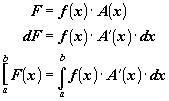
second step involves defining an instantaneous change for the function by
writing what is called a differential. Differentials are of the form:

Dividing both sides by the
infinitely small, dx, defines the
derivative or instantaneous rate of change of
 with respect to x. What is important to understand is
that
with respect to x. What is important to understand is
that
 is assumed to be
constant over the interval, dx. Thus
the infinite sum of these dx. s is
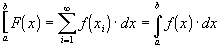
given by integrating the function. The net change in the function, F(x) , over an interval form x = a to x = b is thus:
is assumed to be
constant over the interval, dx. Thus
the infinite sum of these dx. s is
given by integrating the function. The net change in the function, F(x) , over an interval form x = a to x = b is thus:
Let us now look at various
combinations of f(x) and x, and see how we differentials are
defined for each case. Consider case 1,
where some situation, F is a function
of two independent conditions f and x,

If f is a function of x, f(x), then its value changes as x changes. The differential is defined by converting the independent x into an infinitely small dx.

The differential is then integrated
to determine how much the situation, F, changes as x changes from x = a to x = b.
Consider case 2 where F is a function of two independent conditions, f and


In this case,
 represents a fixed or
constant condition. We can replace A
with
represents a fixed or
constant condition. We can replace A
with
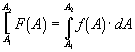
 to get:

If f is given as a function of x,
then we will first have to re-write f(x)
as a function of A. We know that:

If
 , then
 . Once we have
 , we can write our differential;

We can then integrate this function
from some value of
 . Keep in mind that,


This approach to writing and
integrating the differential for case 2 functions is confusing and abstract. An
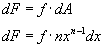
easier and more logical approach is to integrate with respect to x only: For example if,

First let
 , then
  or:
or:

Substituting
this back into the function yields:
If f is a constant then from x =a to x = b, the change in F
is:
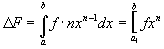
The result is the same function we
started with. If f were a function of
x, then its value would change as x goes from a to b. The differential can be written as:

Integrating this
function over an interval from x = a to x = b results in
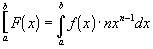
This results in the same numerical
answer as the previously defined method of writing the differential.
To summarize, if
 ; and f is a
function of x, then:
; and f is a
function of x, then:
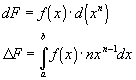
Here
 , where

The third case of writing a differential is for functions of the form:

Once again,
 is a constant factor
that defines F. We can let
is a constant factor
that defines F. We can let
 , then:
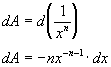
Substituting
this back into case three:
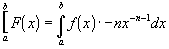
Our results can be generalized as
follows. If F is a function of two
variables, f and x such as:

If A is some function of x,
and f is also a function of x then both these values change as x
changes. It is important to understand that
 is a constant value,
dependent on x, that defines F. Therefore, the differential is
defined as:
is a constant value,
dependent on x, that defines F. Therefore, the differential is
defined as:

Since A is a function of x, then:

Substituting this back into the
differential gives us the general expression:

We can integrate this over any
interval of
 to find the net
change in F over the interval. Our
results can be generalized for any combination of
to find the net
change in F over the interval. Our
results can be generalized for any combination of
 and
and
 , where
 and
and
 can represent any function of x. The differential and integral is: